
I Left America Two Years Ago. Have I Changed?
Context
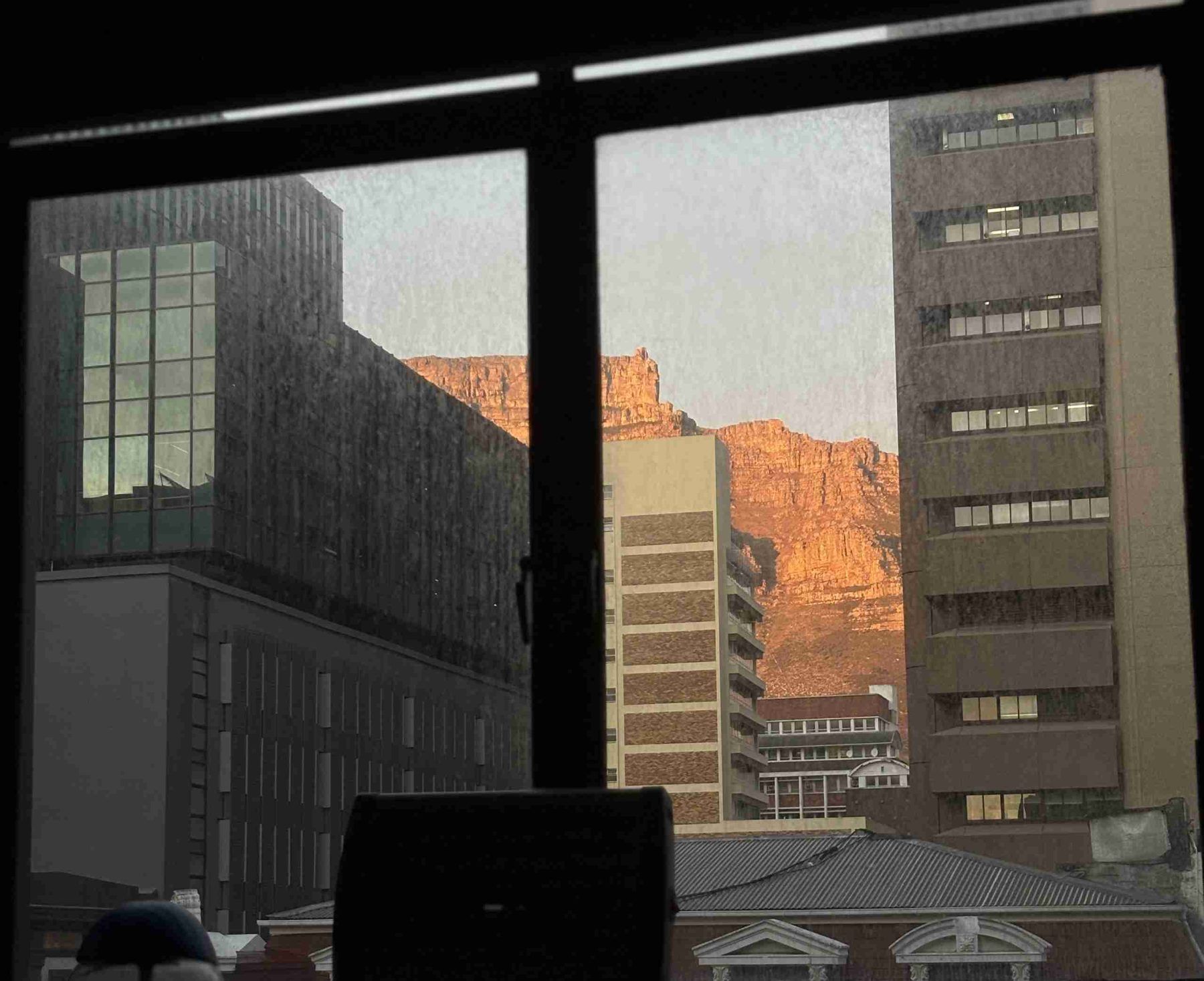
Standing in my kitchen wearing Birkenstocks and ink-black Issey Miyake pleated slacks, the sun's tapering light casting Table Mountain aglow in golden pinks and yellows, I fingered the strap of my tote bag, debating whether to walk the four blocks to Truth Coffee. It wasn’t quite dusk, but late enough to worry I might not make it there before dark. Sunlight disappears quickly this close to the South Pole, and people don’t linger outside once the street lights come on. They make a point to get where they’re going, or they don’t go at all. Even though my boyfriend isn’t here, his voice whips through my mind. “Take an Uber” he’d say, “you don’t walk when it’s this dark.” Sometimes I feel he's paranoid, but I've learned not to trust my instincts in this context. Violence in downtown Cape Town is opportunistic and people can tell I’m American. It’s a fine line between bravery and bravado, and so I decide not to chance it.
I hopped into the back of the white Toyota Etios and greeted the driver. Hello howzit? Piiin numba please? Identity confirmed, we made a quick left toward Adderley Street, skirting past the clutch of call center workers smoking cigarettes and spilling into the road like they’d just let out of the club. We ran the red and slid into the flow of traffic. I enjoy these small acts of disobedience. Why wait at a red light when no one's around? I grew up around a lot of obedient people, rule followers who would expose a stupid rule and then obey it. I used to judge, but as I got older and faced similar choices, I understood why many people keep their protests private. Whether thinking I knew better or feeling I had no choice, I fought back– again and again– advocating for myself, challenging those stupid rules, and pushing for that elusive internal change. I did alright, but the whole performance exhausted me, and the wounds of battle– and they are battles– rarely seemed worth the negotiated peace that followed. Soon enough, it felt like my whole life was about fighting. I desperately needed a break, and so I packed my shit and flew to Cape Town.
Immigration is a peculiar thing. On the one hand, I’m exactly who I’ve always known myself to be; and yet, by virtue of this singular decision to leave America, I am changed. I’ve moved a few times as an adult, and yet reminders of my otherness still catch me by surprise; like when I realized Black Africans didn’t consider me Black.
It happened a few months into my trip while having dinner with a diverse group of friends from across Africa—Xhosa and Zulu South Africans, Ugandans, Namibians, Kenyans, and Sudanese. We were discussing Black identity, but something about the conversation was unfamiliar to me. They referenced cultural cues I'd never heard of and interspersed their English with their own languages, sometimes making their plots hard to follow. Their humor was different, and their stories focused on details I would have ignored. In effect, they were describing and defining African experiences of Blackness. They were talking about something that cannot be explained, only embodied: themselves, African Blacks raised in Africa within tribes that stretch back to the first humans. That’s not me. It can never be me. I’m American. And in a country where a foreigner's nationality matters more than their pigmentation, I might as well be White.
As an American in South Africa, I have privileges. Some are subtle, like when people in Cape Town interact with me as an expat—curious about my background—while non-Nigerian Black people are derogatorily called immigrants, or even 'Africans', and dismissed. Other privileges, like protection, are implied. Protection is different from safety; the latter is individual and contextual, while the former is general and transcendent. Protection is the feeling that if I’m in trouble the Marines are coming to rescue me. Even though that won’t happen, we move with the swagger of power– assertive and knowing– expecting safety and demanding respect. Nevermind that we are like toddlers in a circus, wholly unprepared and practically oblivious to the less obvious and more violent assertions of power that suffuse lands beyond our borders, blithely treading ire’s edge.
When so much has been taken, honor, dignity, and respect become valued currencies. When physical safety is denied en masse, violence follows. Fear and anxiety pervade. It can be jolting for Americans who, until recently, lived in a stable country and did not face constant threats of bodily harm, sexual violence, death, dislocation, dispossession, or betrayal. As the world’s dominant power, our understanding of respect is often so underdeveloped and superficial that we confuse it with deference. Bottle this up with ignorance, arrogance, and lack of insight and the effect can be startling. Trying to be proudly American and a person of conscience, sensitive to the unfair power that might cause me to inadvertently wield colonial violence in the Global South can sometimes make me feel like a striving oaf, earnestly perhaps futilely, sandpapering granite into silk.
I’ve been out of the States for two years now, laying low and biding my time. For what exactly, I am not sure. I lost track of those questions when I got windmilled by the dissonance that characterizes daily life in Cape Town: shocking poverty amidst shocking wealth, raw power and brazen corruption alongside extreme generosity and humanity, unbelievable suffering and inconvenience deflated by easy humor and song.
I am learning how to exist morally and consistently within such tensions, and I don’t know if I have anything more than my intention, courage, and pierced innocence to show for my efforts. But I can say that in these past two years I do think I’ve gained some perspective– and for me, especially these days, that’s more than enough.